
The Art of Time: How a Darkroom, a Brother and a Magic Trick Shaped Mathew Guido's Vision
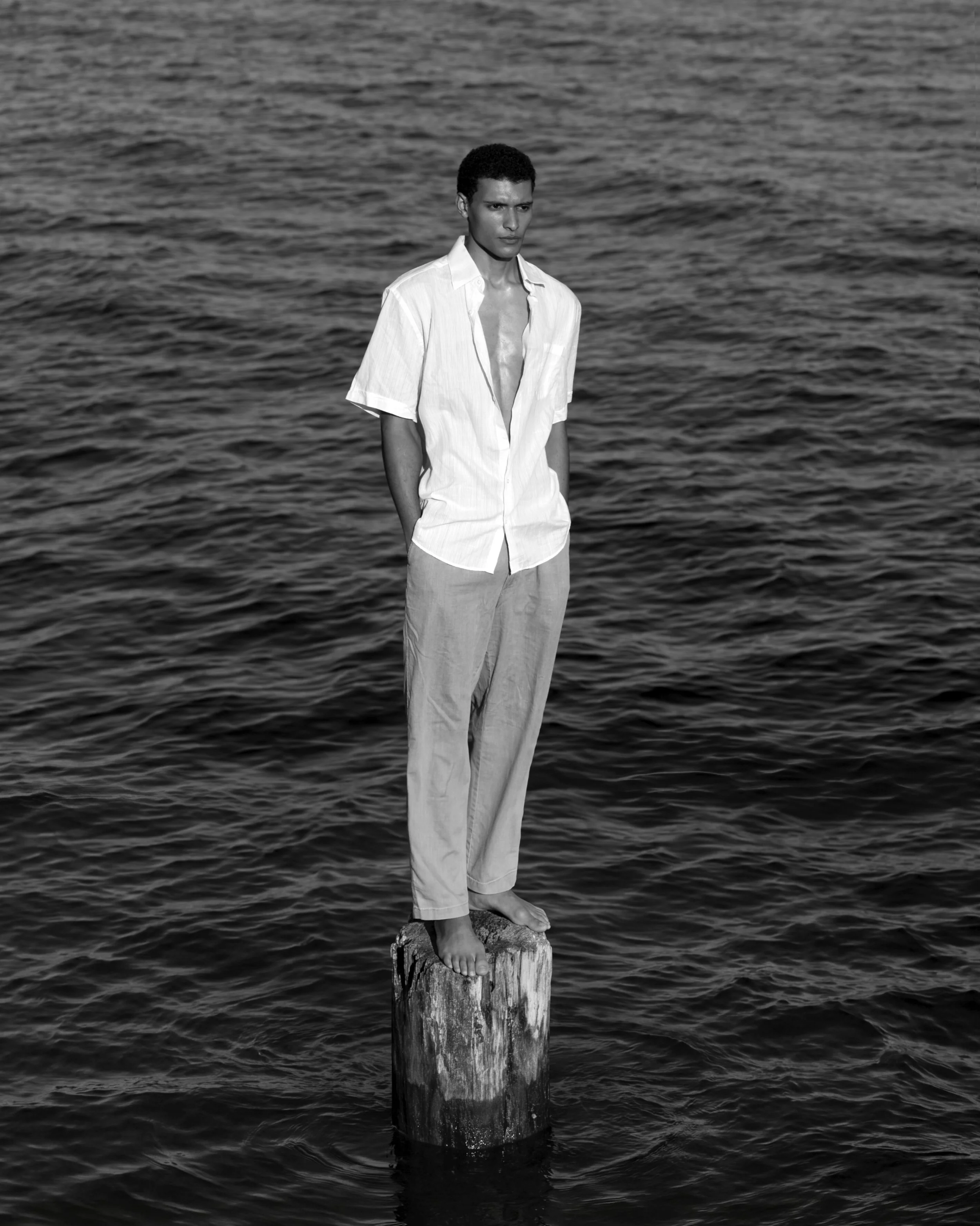
One of Mathew’s favourite photos
The first photograph Mathew Guido ever fell in love with wasn't one he took. It appeared slowly under the red glow of a high school darkroom, in his older brother Daniel's hands. Mathew was in Grade 8. Daniel, four years older, had asked him to pose for a series of black-and-white film portraits, then brought him into the darkroom to watch them come to life. To a young boy it felt like a magic trick: a fraction of a second, caught and kept.
He couldn't wait to be old enough to return to that same room and make that magic himself. That summer, Daniel passed away.
Before Mathew had even started, photography became something more than an art form to him. It became a way of holding onto time. That early awareness of how fleeting things are still runs through everything he creates. His images sit somewhere between reality and memory. They are richly imagined, carefully built worlds, and underneath each one is a quiet effort to keep a feeling from slipping away.
Today, Mathew is a celebrated fashion and commercial photographer, a builder of creative companies, and a mentor to emerging talent across Canada. In this exclusive interview with Models of Canada, he talks openly about loss, the difference between being successful and being fulfilled, and why he wants to see Canada believe in its own talent before the rest of the world does. He also shares the one photograph he'd want at the end of it all. It wouldn't be elaborate. It would just be the people he loves, in the last light of the day.
Models of Canada: Every photographer has a story behind the first time they picked up a camera. Can you take us back to that moment and tell us what made you fall in love with photography?
Mathew: My first real experience with photography happened when I was in Grade 8 through my older brother, Daniel, who was in Grade 11. He was taking photography in high school and asked me to pose for some creative black-and-white film portraits he was making, using light in a very artistic way. Afterward, he brought me to his high school and into the darkroom with him.
I remember being completely immersed in the red safe light, watching the film develop, trying to understand some of the science behind it, and then seeing an image slowly appear while making a print. It felt like a magic trick. Photography became, in a way, the art of time to me. You could take something that existed for a fraction of a second and somehow hold onto it.
I couldn’t wait until I was old enough to take photography myself, in that same high school and that same darkroom, and experience that magic again. Before I got the chance, Daniel passed away that summer. I never got to return to that experience with him or share that part of photography together again.
That inevitably changed my relationship with photography before I had even really begun. Art, memory and time became intertwined for me very early, and I think they still are.
Models of Canada: Looking back at your career, was there one defining moment that made you realize, "This is what I'm meant to do”?
Mathew: I don't think it was a particular job, award or career milestone. The moment was much more internal.
It happened when I finally learned how to absorb all of my references without feeling like I was simply referencing them. Photography, cinema, music, painting, fashion, animation, lighting, fantasy, emotions, all of these things I loved started dissolving into one another until I could make something that felt unmistakably like my own.
That's when things became dangerously fun.
I started entering this flow state where making images felt almost instinctive. It was less about proving that I could take a good photograph and more about realizing I had a point of view.
There was something incredibly meaningful in that realization. It made me feel like my existence mattered in the work, and once I understood that, my perspective became something I wanted to keep developing and protecting.
Models of Canada: Photography often captures everyone else's stories. What is one chapter of your own life that has shaped the way you see the world through your lens?
Mathew: Loss shaped me very early.
Because my introduction to photography is so closely connected to my brother, I think I became aware of time and impermanence much younger than I otherwise would have. Photography became more than an aesthetic pursuit for me. It became a way of stopping something before it disappeared.
I think that's probably why I'm so interested in creating images that feel suspended somewhere between reality and memory. Even when the work is highly constructed, there is usually something underneath it about trying to hold onto a feeling.
As I've gotten older, that awareness has also made me increasingly protective of how I spend my creative life. Time is the only thing we're really spending that we can never earn back. I want the things I create to feel like they were worth that exchange.
Models of Canada: What do you hope people feel, and not just see, when they look at one of your photographs?
Mathew: I want them to feel transported.
I've never been particularly interested in showing reality exactly as it exists. I'm much more interested in what reality can become once imagination gets involved.
Sometimes that means beauty, sometimes mystery, tension, nostalgia or even a slight sense of uneasiness. I love images that feel familiar enough to enter but strange enough that you want to stay with them for a while.
Ideally there is a moment where someone stops thinking about the technical construction of the photograph and simply feels something.
If somebody remembers the feeling of an image after they've forgotten the clothes, the lighting or even who was in it, that means much more to me.
Models of Canada: Creative careers are filled with both incredible highs and difficult lows. Can you share a challenge that changed you, and what it taught you about yourself?
Mathew: One of the biggest challenges has been learning the difference between being successful at photography and actually being fulfilled by photography.
There are periods in any creative career where you become very good at solving other people's problems. You understand what clients need, what the market responds to and what will get approved. There is real skill in that, and I'm grateful that commercial photography has allowed me to build a life around making images.
But you can also become so efficient at delivering what is expected that you stop asking what excites you.
I've had to consciously return to that question many times.
The lesson for me has been that my curiosity has to remain more powerful than my comfort. Whenever I start feeling too comfortable, I need to experiment, make something unnecessary, collaborate with someone unexpected or enter a space where I don't completely know what I'm doing yet.
I've learned that I am happiest when there is still some possibility of failure in the room.
Models of Canada: If you could photograph one person, living or gone, for just one hour, who would it be and what conversation would you hope to have with them?
Mathew: I think I would photograph Caravaggio.
I’ve always been fascinated by the way he used light, not just to illuminate a subject, but to create emotion, tension and meaning. There is something incredibly modern about the way his figures emerge from darkness. The light feels psychological as much as visual.
I’d want to talk to him about instinct. How much of what he was doing was deliberate, and how much simply came from the way he naturally saw the world? I’d also want to know whether he understood how radical his work was while he was making it.
And selfishly, I’d want to see his face under my own lighting. I think there would be something really interesting about photographing an artist whose use of light has influenced the way I think about images centuries later.
Models of Canada: Behind every successful artist is a human being. Outside of photography, what keeps your heart full, inspires you, or reminds you who you are?
Mathew: The people I love are probably the clearest answer.
Photography can become incredibly consuming because almost anything can turn into creative material. Music, films, conversations, faces, architecture, an unusual shadow on a wall. My brain has a difficult time not collecting things.
So the parts of my life that bring me back to being a person instead of constantly being an image-maker are really important to me.
Being at home, sharing food, spending time with family and the people closest to me, listening to music without needing it to become a reference, those things reset me.
And more recently, mentoring and developing emerging talent has unexpectedly become another source of fulfillment. There is something really beautiful about recognizing possibility in somebody before they necessarily know what to do with it themselves. It takes me outside of my own career and reminds me that creativity can also be something you give away.
Models of Canada: Fashion photography is rarely a solo effort. It's built on collaboration. What has it been like working with agencies, models, and fellow creatives throughout your career, and what changes or growth do you hope to see in the Canadian fashion industry over the next decade?
Mathew: Collaboration has probably taught me more than any technical part of photography ever could.
Eventually you realize that a great fashion photograph isn't really made by one person. A model, stylist, hair artist, makeup artist, producer, agency and photographer are all bringing something into the same moment. My role is often less about controlling all of those contributions and more about creating a world strong enough that everyone understands where we are going and has permission to be a part of it.
Working more closely with developing models has given me another perspective on that ecosystem as well. I'm now thinking about talent before they ever arrive on a set: what makes someone distinctive, what needs development, what market might understand them and how the right imagery can actually change the trajectory of their career.
That has made me even more interested in what Canada could become.
We have extraordinary creative talent here, but I think we can sometimes be overly cautious. There is a tendency to favour what is immediately commercial, familiar or proven. I would love to see the next decade bring more investment in distinct voices, stronger development of emerging talent and more confidence in exporting Canadian creatives internationally.
I don't think we should need another market to tell us somebody is special before we believe it ourselves.
Models of Canada: If your younger self, the one just starting out, could see where you are today, what do you think they would be most proud of, and what advice would you give them?
Mathew: I think he would be proud that I never stopped.
Not because everything worked out exactly as I imagined. It absolutely didn't. But somehow this thing that fascinated me in a darkroom as a kid became the language through which I built my entire adult life.
I think he would be amazed that imagination became an actual profession. That I would eventually work with people and brands I once only saw in magazines, travel through the work, build companies around creativity and eventually be in a position where other young people would trust me with the beginning of their own careers.
The advice I would give him is not to rush so much.
When you are young, you think you need to arrive somewhere. You look sideways constantly and assume everybody else knows something you don't.
I would tell him to pay much more attention to what he finds genuinely interesting, especially the things that seem strange, obsessive or difficult to explain. Those are usually the clues.
Your taste is trying to tell you who you are long before your career catches up.
Models of Canada: When your career is one day looked back on, what legacy do you hope you've left, not just as a photographer, but as a person?
Mathew: I hope people feel that I made possibility feel a little bigger.
That could mean through an image, through giving somebody an opportunity, recognizing talent in them, encouraging an idea, introducing two people who should know one another or simply taking someone seriously at a moment when they needed that.
I obviously want to leave behind photographs that feel like mine. A body of work with a recognizable imagination running through it.
But I don't think the work is enough on its own.
As I've gotten older, I've become much more interested in what happens around the photograph: the relationships, the people who develop because you believed in them, the opportunities that exist because you opened a door.
If my career eventually becomes evidence that you can build an entire life around curiosity while also helping other people build theirs, I would feel very fulfilled by that.
Models of Canada: If your life were captured in one final photograph, what would it look like, who would be in it, and why?
Mathew: It actually wouldn't be one of my elaborate photographs.
I imagine something extremely simple, probably late in the day when the light is beginning to disappear. The people I love would be there. Nobody would be performing for the camera and nothing would be particularly perfect.
I think I would want it to feel almost like a photograph that wasn't supposed to become important.
Because after spending my life controlling light, constructing worlds and trying to make individual moments feel extraordinary, the final photograph would probably remind me that the extraordinary thing was having the time in the first place.
And maybe that brings everything back to where photography began for me.
A fraction of a second that you somehow get to keep.
Written by: Models of Canada
See more of Mathew Guido at MathewGuido.com